When Should You Replace Industrial Flooring?
Argelith •
October 13, 2026
Commercial flooring works harder than flooring in most other environments. In food processing facilities, automotive shops, and industrial plants, floors may face heavy equipment, rolling loads, chemical exposure, oils, moisture, temperature changes, and rigorous cleaning protocols every day.
Even a floor that initially performs well can eventually reach a point where ongoing repairs and maintenance no longer make operational or financial sense. Knowing when to replace flooring can help facility managers address problems before they interfere with safety, sanitation, productivity, or
long-term operating costs.
When Is It Time to Replace a Commercial Floor?
A damaged area does not automatically mean an entire floor needs replacement. Isolated problems can sometimes be repaired effectively. However, widespread deterioration or recurring performance issues may indicate that the existing flooring system can no longer meet the facility’s demands.
Before moving forward with replacement, it is important to identify the source of the damage. Cracking or recurring issues may originate below the finished floor, including problems with the substrate, movement joints, drainage design, or original installation. Addressing the underlying cause helps ensure that the same issues do not carry over into a new flooring system.
Here are five signs it may be time to consider replacement.
1. Cracks, Chips, and Surface Damage
Cracks, chipped edges, spalling, and other visible deterioration should be evaluated carefully, particularly when damage appears throughout the facility.
Beyond appearance, damaged surfaces can create areas where water, oils, food residue, or other contaminants collect. Uneven sections can also make it more difficult to move carts, equipment, and vehicles efficiently.
A few isolated chips may call for targeted repairs. When damage becomes widespread or repeatedly returns after repair, replacement may provide a more practical long-term solution.
2. Slip and Safety Concerns
Flooring plays an important role in supporting safer working conditions.
Food and beverage facilities frequently deal with water and other liquids. Automotive shops encounter oils, lubricants, and automotive fluids. Industrial environments may face process liquids or contaminants specific to their operations.
If the existing surface no longer provides appropriate slip-resistant characteristics for the environment, or deterioration has created uneven walking and working surfaces, it is time to reassess the flooring system.
The replacement floor should be selected according to the facility’s actual operating conditions, including anticipated contaminants, traffic, cleaning practices, and required surface characteristics.
3. Frequent Repairs and Rising Maintenance Costs
Repeated patching can become expensive.
When maintenance teams continually repair cracks, joints, or damaged sections, the facility pays not only for materials and labor but also for potential production interruptions and restricted access.
Track how often flooring repairs are required and what they actually cost. If the repair cycle is becoming shorter while expenses continue to rise, investing in a longer-lasting flooring solution may offer better value over the floor’s service life.
4. Cleaning Is Getting More Difficult
A commercial floor should support the facility’s cleaning requirements rather than make them more complicated.
Cracks, damaged surfaces, deteriorating joints, and uneven areas can trap grime and make routine cleaning more labor-intensive. This is particularly important in food and beverage environments where hygienic design and effective cleaning practices are operational priorities.
When normal cleaning processes no longer produce satisfactory results, evaluate whether the problem is the cleaning procedure or deterioration of the flooring system itself.
Fully vitrified ceramic tile has a dense structure and an ultra-low absorption rate. This helps prevent liquids from penetrating the tile itself and supports effective cleaning in demanding environments when the tile is paired with an appropriately specified grout and installation system.
5. The Floor No Longer Meets Facility Demands
Sometimes the floor has not changed, but the operation has.
A facility may add
heavier equipment, increase production, introduce different chemicals, change cleaning procedures, or experience substantially more traffic than the original floor was selected to accommodate.
Flooring should match current operating conditions. If the facility has evolved beyond the capabilities of the existing system, replacement provides an opportunity to specify a solution around today’s performance requirements.
Industry-Specific Signs of Floor Wear
Different industries place different stresses on flooring. Recognizing those differences is essential when deciding whether repair or replacement is appropriate.
Food & Beverage Facilities
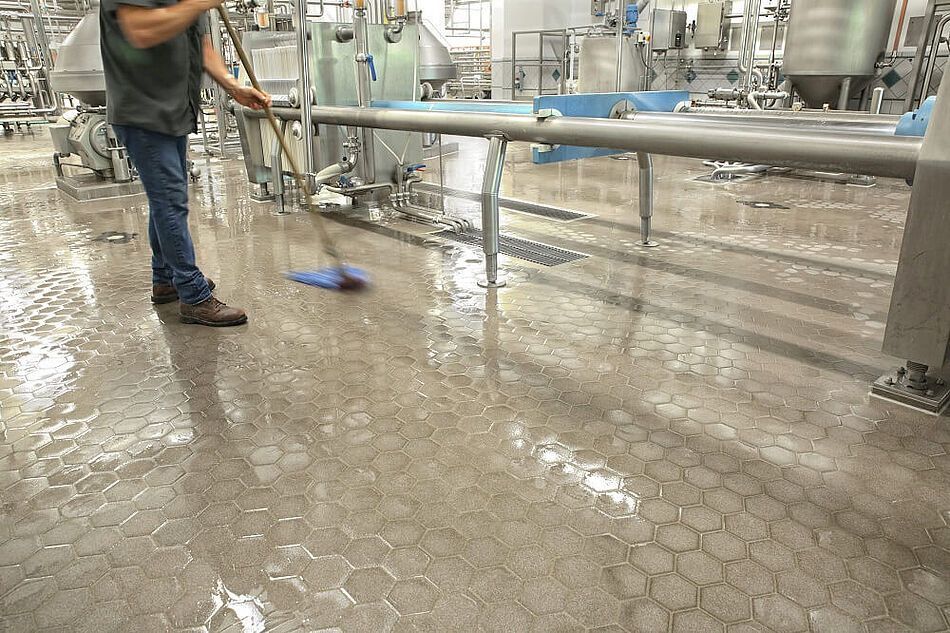
Breweries, commercial kitchens, processing plants, and other food and beverage operations can expose flooring to moisture, spills, food byproducts, chemicals, thermal changes, and intensive cleaning.
Warning signs include damaged grout joints, cracking, areas that retain standing water, and surfaces that are becoming increasingly difficult to clean.
When installing a new tile system, grout selection is especially important. Cementitious grout may not be appropriate for chemically intense environments, so epoxy grout should be considered when conditions require greater chemical resistance. Properly sized and completely filled grout joints can help reduce areas where water and debris may collect while minimizing exposed tile edges.
Automotive Shops
Automotive service areas require floors capable of handling vehicle traffic, heavy equipment, oils, automotive fluids, and frequent cleaning.
Recurring surface deterioration, damaged areas around lifts and service bays, or increasing maintenance demands can indicate that the existing flooring system is reaching the end of its practical service life.
Fully vitrified ceramic tile is well suited to demanding
automotive environments because its dense structure supports long-term performance under heavy traffic while offering chemical-resistant and slip-resistant options appropriate for service areas.
Industrial Facilities
Manufacturing and industrial facilities may subject floors to concentrated loads, rolling traffic, chemicals, abrasion, and around-the-clock operations.
Facility managers should pay close attention to recurring damage in high-traffic routes, production areas, loading zones, and locations surrounding machinery. Frequent localized repairs across multiple areas can indicate a larger flooring performance issue.
Should You Repair or Replace Your Commercial Flooring?
The decision comes down to the condition of the existing system and the economics of keeping it operational.
Repair may make sense when damage is isolated, the surrounding floor remains sound, and the repair restores the necessary performance.
Replacement becomes more compelling when deterioration is widespread, repairs repeatedly return, cleaning requirements are increasing, or the floor no longer supports the facility’s operational needs.
The decision should consider the total cost of ownership, not simply the initial cost of replacement.
The Long-Term Cost of Short-Lived Flooring
The Long-Term Cost of Short-Lived Flooring
A lower initial flooring investment does not necessarily mean a lower long-term cost.
The true cost of a commercial floor extends across its entire service life. Repair materials, cleaning and maintenance labor, production downtime, resurfacing, and replacement frequency can all add significantly to the original material and installation costs. A flooring system that requires repeated repairs, intensive maintenance, or premature replacement may ultimately cost far more than its initial price suggests.
A floor engineered for the facility’s actual environment may require a greater upfront investment, but longer service life and reduced repair, maintenance, and replacement demands can provide greater lifecycle value.
For facilities expected to remain operational for decades, flooring specifications should consider total lifecycle cost—not simply the initial investment.
Choosing a Floor Built for Long-Term Performance
Argelith Ceramic Tiles engineers fully vitrified ceramic flooring solutions for demanding commercial and industrial environments. Drawing on a German engineering heritage and decades of technical expertise, Argelith develops flooring solutions for environments exposed to heavy traffic, rigorous cleaning, chemicals, moisture, and other demanding operating conditions.
Fully vitrified construction creates an exceptionally dense tile with an ultra-low absorption rate, helping prevent seepage into the tile while supporting long-term hygiene and performance. Different surface options can also address the slip-resistance requirements of specific applications without sacrificing cleanability or appearance.
Depending on project requirements, fully vitrified tiles can be installed using thinset or vibration installation methods. Tile selection is only one part of a successful flooring system. Substrate preparation, grout selection, installation quality, drainage, cleaning practices, and ongoing maintenance all contribute to long-term performance.
Argelith works with qualified installers, and using an experienced installation team is essential for achieving the intended performance of the complete flooring system.
Plan Your Next Flooring Project
can no longer keep pace with operational demands, it may be time to evaluate replacement.
Argelith’s US-based team works with facility owners, architects, general contractors, and qualified installers to identify tailored flooring solutions for demanding food and beverage, automotive, and industrial projects.
Request a consultation for a flooring solution tailored to your facility, or explore Argelith’s high-performance engineered tiles.
Disclaimer: Floor performance characteristics depend on proper product selection, substrate preparation, installation methods, site conditions, and ongoing maintenance. Slip resistance ratings and hygienic performance may vary based on use conditions, cleaning practices, and environmental factors.